
205. Can You See Stuff In Your Head?
3/20/2026
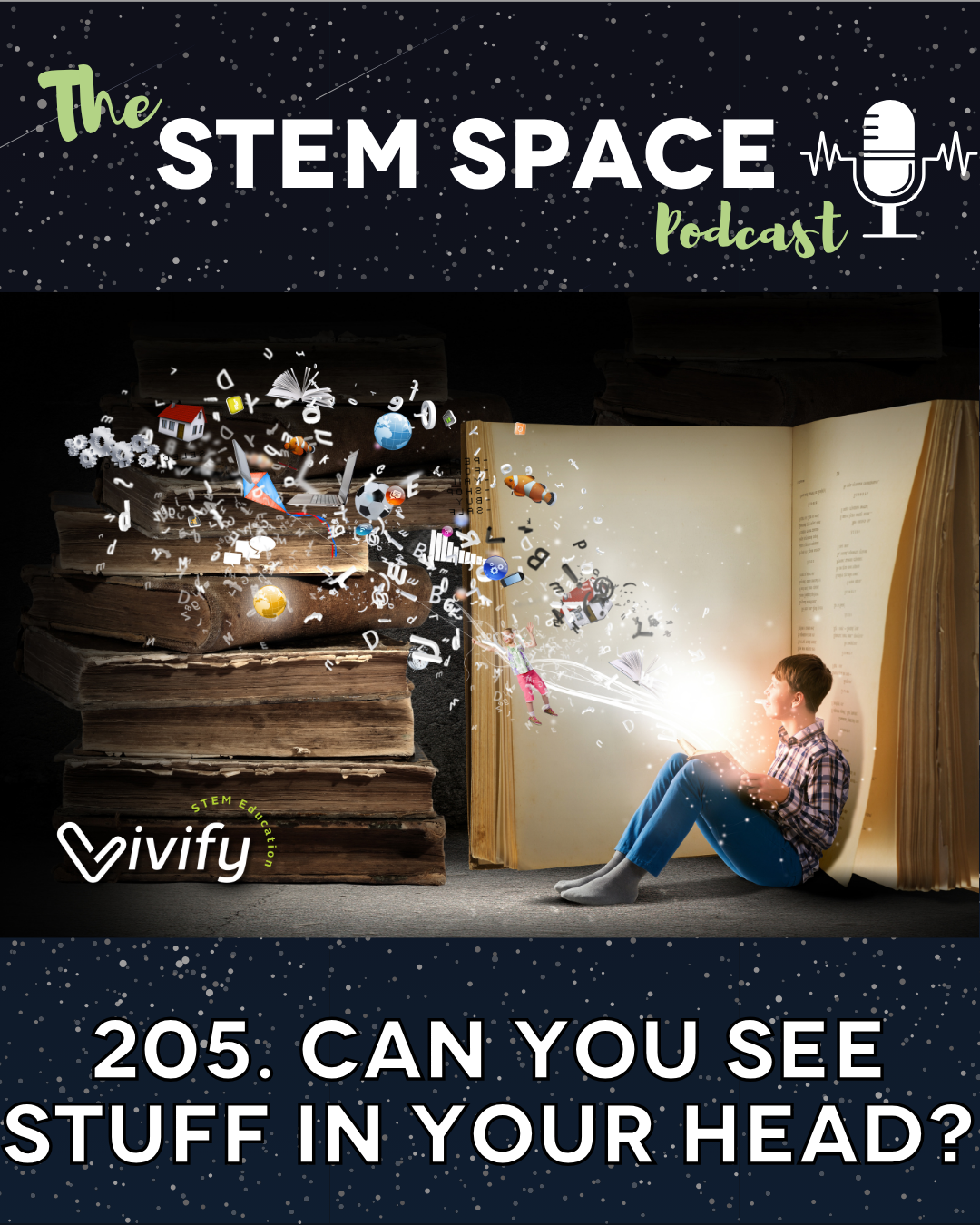
In this episode of The STEM Space, we explore the fascinating world of the mind’s eye. Some people can picture vivid images in their minds, while others see nothing at all—so where do you fall on the imagination spectrum? We’ll dive into the science of visual perception while learning about modern neuroscientist Margaret Livingstone and her work uncovering how the brain processes visual information. Plus, grab your free classroom lesson inspired by this research and stay tuned for the latest top feats of STEM in the news.

STEMist SPOTLIGHT: Dr. Margaret Livingstone has spent her career uncovering how the brain turns light into meaning, showing that what feels effortless - recognizing color, motion, faces, and form - is actually the work of specialized pathways working together behind the scenes. Drawn to both science and art from a young age, she earned her Ph.D. in neurobiology at Harvard and went on to map how different parts of the visual system process information. Her research revealed why certain artworks seem to glow or move and how artists have long tapped into the brain’s visual circuitry, insights she later shared in Vision and Art: The Biology of Seeing. Her work has shaped fields from neuroscience and psychology to art, display technology, and virtual reality, reminding us that while our eyes capture the world, it’s the brain that creates what we see.
Click below to watch or listen to this episode of The STEM Space!
You can also download the episode on your favorite podcast app.
Check out the full video above or the edited audio podcast episode of our discussion below!
Links from the Show:
Related The STEM Space Podcast Episodes
Vivify STEM Blog Posts
Vivify STEM Lessons
STEM Creativity Tools: 5 Activities to Boost Brainstorming Power
Astronaut Training: 4C's of STEM Middle School Unit | Engineering Our Cosmos
Other STEM Resources
The Vividness of Visual Imagery Questionnaire at Aphantasia Network
In STEM News
What Do Mummies Smell Like? The Answer Is Revealing Ancient Secrets - Scientists at the University of Bristol discovered that the distinctive scent of Egyptian mummies comes from chemicals left behind by embalming ingredients such as oils, beeswax, plant resins, and bitumen. By analyzing tiny samples of air around mummy fragments, researchers identified dozens of chemical compounds that reveal how mummification techniques evolved and became more sophisticated over more than 2,000 years. https://www.sciencedaily.com/releases/2026/03/260315225153.htm
New “Jerk” Signal Could Warn of Volcano Eruptions Hours in Advance - Scientists from the Institut de Physique du Globe de Paris and the GFZ Helmholtz Centre for Geosciences developed a method called the “Jerk” detector that identifies tiny ground movements caused by magma rising underground. Tested for ten years at the Piton de la Fournaise volcano, the system successfully predicted **92% of eruptions—sometimes up to eight hours in advance—**offering a promising new tool for early volcanic warning systems. https://www.sciencedaily.com/releases/2026/03/260315004411.htm
Smart Underwear Reveals the Truth About Farts - Scientists at the University of Maryland created “Smart Underwear,” a wearable sensor that measures hydrogen in intestinal gas to track how often people pass gas. Early results show people may fart about **32 times per day on average—more than twice previous estimates—**while the technology could help researchers better understand gut microbes and digestive health. https://www.sciencedaily.com/releases/2026/03/260314030516.htm
Subscribe and Leave a Review:
Subscribe to The STEM Space podcast to get the latest episodes full of useful links and resources for your STEM education journey. Click here for iTunes.
Please leave us a review here and let us know what you think of our show. We would love to hear from you and are truly grateful for your support so that we can continue to produce helpful content! Click here and select “Ratings and Reviews”, then “Write a Review”. Thank you so much!