206. How to Turn Off Your Selective Attention
3/27/2026
What if turning off your selective attention could actually make you more creative? In this episode of The STEM Space, we explore how the brain filters information—and why loosening that filter might be the secret to innovation.
You’ll also meet Ellen Swallow Richards, the chemist, environmental scientist, and sanitary engineer who transformed public health by revealing the hidden dangers in everyday water. Plus, we highlight several accidental scientific discoveries that changed the world in unexpected ways.
Don’t forget to grab the free lesson that goes along with this week’s STEMist spotlight, and stick around for the latest STEM news from around the world!
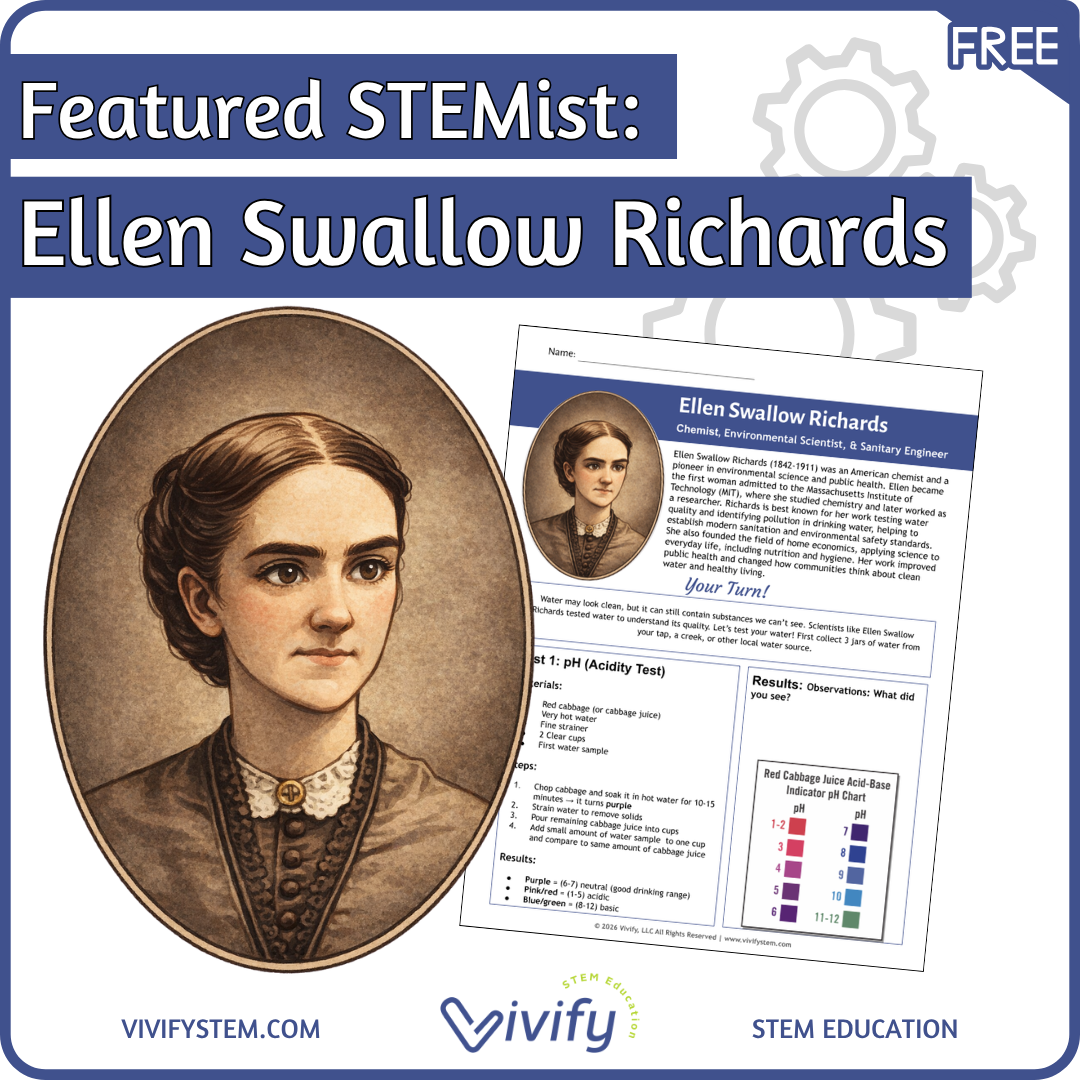
STEMist SPOTLIGHT: Ellen Swallow Richards (1842-1911) was an American chemist and a pioneer in environmental science and public health. Ellen became the first woman admitted to the Massachusetts Institute of Technology (MIT), where she studied chemistry and later worked as a researcher. Richards is best known for her work testing water quality and identifying pollution in drinking water, helping to establish modern sanitation and environmental safety standards. She also founded the field of home economics, applying science to everyday life, including nutrition and hygiene. Her work improved public health and changed how communities think about clean water and healthy living.
As always, we have a free student activity that goes with our featured STEMist that you can find in our STEM Explorer Library using the image to the left or the link below (listed in under Vivify STEM Lessons).
People Who Discovered Things Accidentally vs. Hypothesizing First
Roy Plunkett
Accidental Discovery: Teflon (1938) - A gas he was experimenting with turned into the slippery solid that is now used in nonstick cookware!
Percy Spencer
Accidental Discovery: Microwave Oven (1947) - While working with radar equipment, a chocolate bar in his pocket melted. Curious, he experimented and invented the microwave oven!
Stephanie Kwolek
Accidental Discovery: Kevlar (1965) - She created a strange, cloudy solution that looked like a failed experiment. She was able to turn it into one of the strongest materials ever made!
Wilhelm Roentgen
Accidental Discovery: X-rays (1895) - He noticed a glowing screen while experimenting with cathode rays. He realized he had discovered a new kind of invisible radiation, allowing us to see inside the human body!
Alexander Fleming
Accidental Discovery: Penicillin (1928) - He noticed that mold growing on a petri dish had killed nearby bacteria. Instead of throwing it away, he investigated and discovered the first antibiotic!
Ruth Wakefield
Accidental Discovery: Chocolate Chip Cookies (1930s)- She expected chocolate to melt into dough, but it didn’t. Although versions existed that preceded hers, she is credited with creating the first chocolate chip cookies!
Click below to watch or listen to this episode of The STEM Space!
You can also download the episode on your favorite podcast app.
Check out the full video above or the edited audio podcast episode of our discussion below!
Links from the Show:
Related The STEM Space Podcast Episodes
Vivify STEM Blog Posts
Vivify STEM Lessons
FREE! - What is in the Air? - A Middle School Environmental Science Unit
STEM Creativity Tools: 5 Activities to Boost Brainstorming Power
Who is an Engineer or Scientist? STEM Career Game & Activity
Other STEM Resources
YouTube: Selective Attention Test from Daniel Simons and Christopher Chabris
That Fatigue You Feel Might Just Boost Your Creativity | Psychology Today
In STEM News
Why Mosquitoes Always Find You -Scientists from Georgia Institute of Technology and Massachusetts Institute of Technology discovered that mosquitoes don’t follow each other—instead, they independently respond to the same cues, especially carbon dioxide from breath and dark visual targets like clothing. Using 3D tracking and millions of data points, researchers found that the combination of CO₂ and dark colors is what most strongly attracts mosquitoes, helping explain their behavior and offering new ideas for more effective mosquito control. https://www.sciencedaily.com/releases/2026/03/260322020247.htm
How Beavers Are Fighting Climate Change - Scientists found that beavers can transform rivers into powerful carbon-storing systems by building dams that create wetlands and trap carbon-rich materials. Over time, these beaver-shaped environments can store significantly more carbon than normal streams—making them a surprising and natural ally in reducing climate change. https://www.sciencedaily.com/releases/2026/03/260322020245.htm
Keep Your Eyes Open - A study from Shanghai Jiao Tong University found that closing your eyes in noisy environments can actually make it harder to hear faint sounds. Researchers discovered that visual input, especially images or videos related to the sound, helps the brain focus, while closing the eyes causes over-filtering that can block out important sounds. https://www.sciencedaily.com/releases/2026/03/260320073819.htm
Subscribe and Leave a Review:
Subscribe to The STEM Space podcast to get the latest episodes full of useful links and resources for your STEM education journey. Click here for iTunes.
Please leave us a review here and let us know what you think of our show. We would love to hear from you and are truly grateful for your support so that we can continue to produce helpful content! Click here and select “Ratings and Reviews”, then “Write a Review”. Thank you so much!